The Voxel valley


Idea projektu
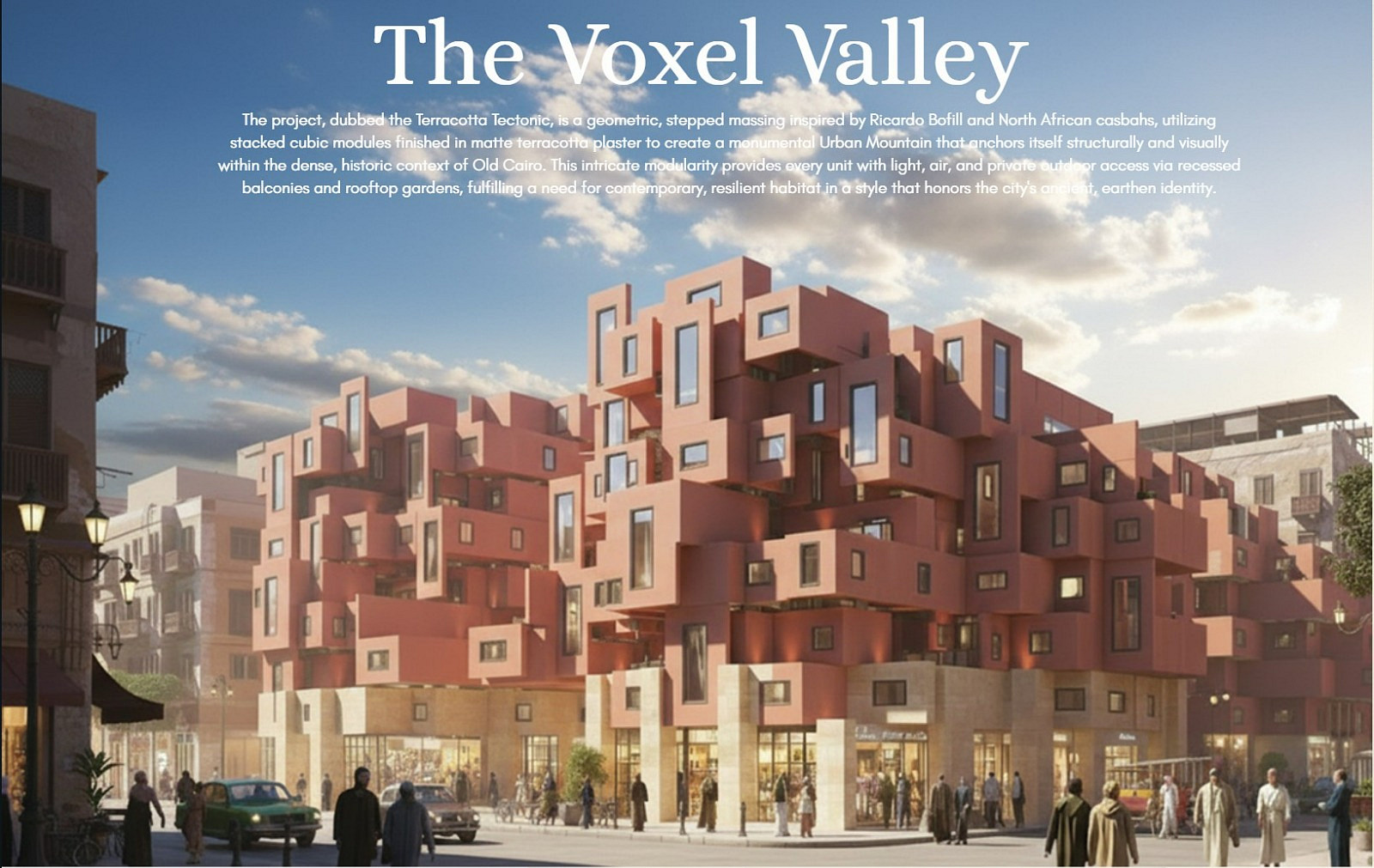
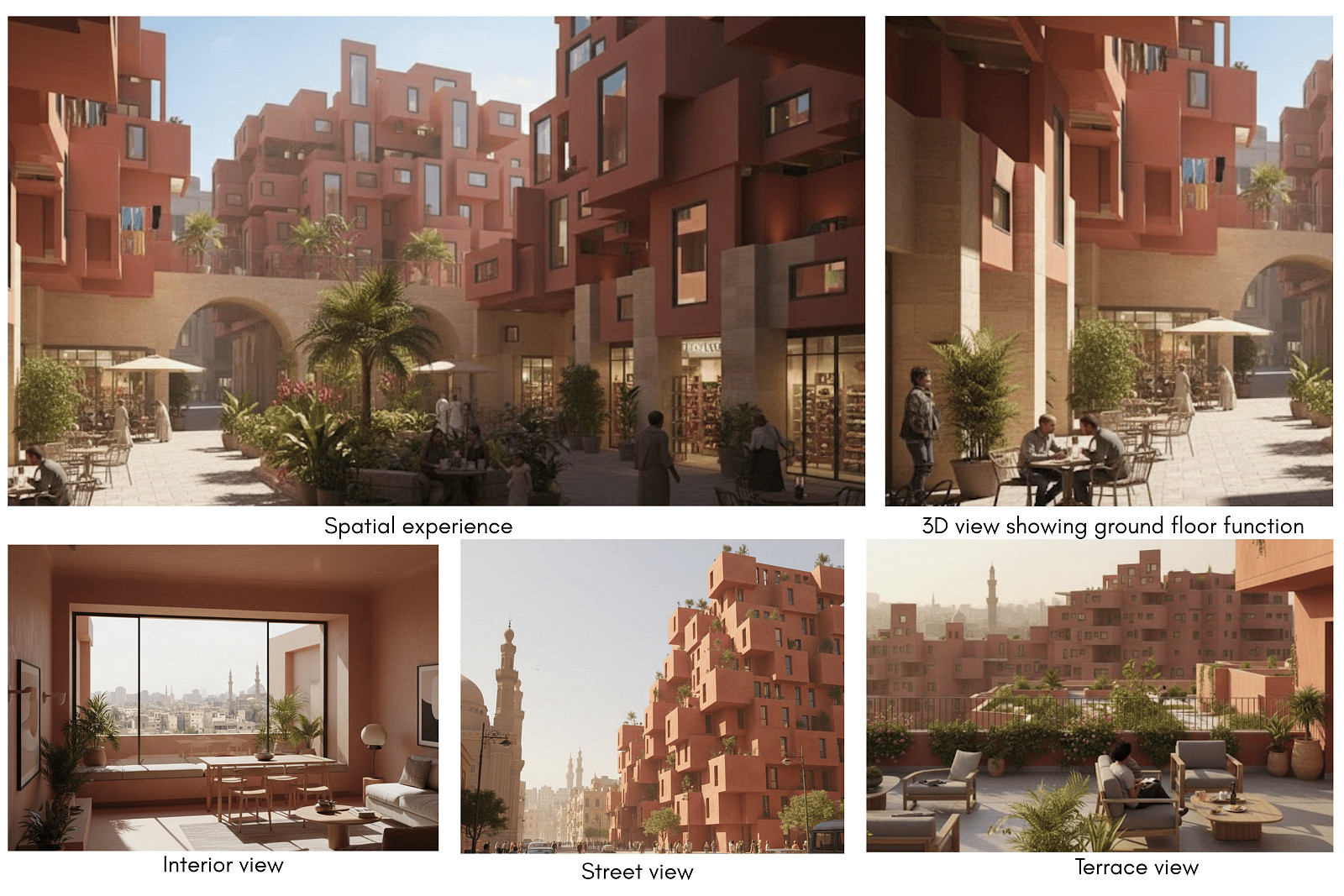
The idea behind the Terracotta Tectonic residential complex is to create a contemporary living environment that emerges naturally from the historic fabric of Old Cairo rather than standing in contrast to it. The project is conceived as an “Urban Mountain,” a stepped architectural form that echoes the density, hierarchy, and organic growth of traditional casbahs while drawing inspiration from the monumental geometry of Ricardo Bofill. Through this approach, the complex becomes a modern reinterpretation of collective living rooted in local identity and memory.
At its core, the project idea is based on modularity and repetition as tools for flexibility and resilience. Stacked cubic units are organized in a stepped arrangement that maximizes light, air, and views for every residence, while creating a dynamic silhouette within the urban context. This modular system allows the building to adapt to human scale despite its monumental presence, ensuring a balance between intimacy and grandeur.
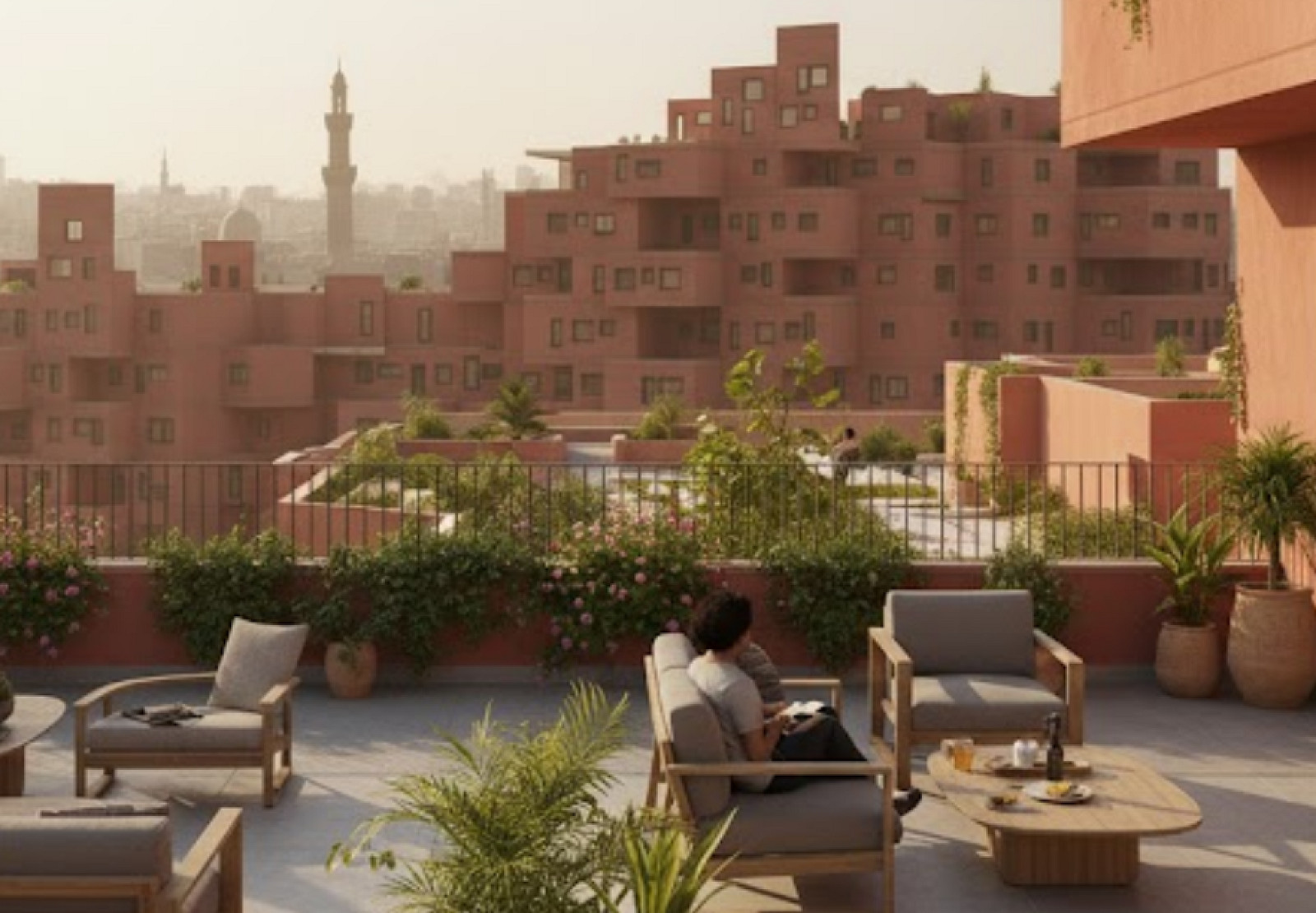
Environmental responsiveness is central to the concept. Recessed balconies, terraces, and rooftop gardens are integrated as essential living spaces, not secondary elements, providing private outdoor areas and improving thermal comfort through shading and natural ventilation. The use of terracotta-toned finishes reinforces this climatic strategy, reflecting heat while visually connecting the building to Cairo’s earth-based architectural heritage.
Ultimately, the project idea seeks to redefine contemporary housing in historic cities by merging cultural continuity with modern living standards. Terracotta Tectonic proposes a residential model that is socially connected, environmentally conscious, and deeply contextual an architecture that belongs to its place while offering a resilient and dignified lifestyle for its residents.
Popis projektu
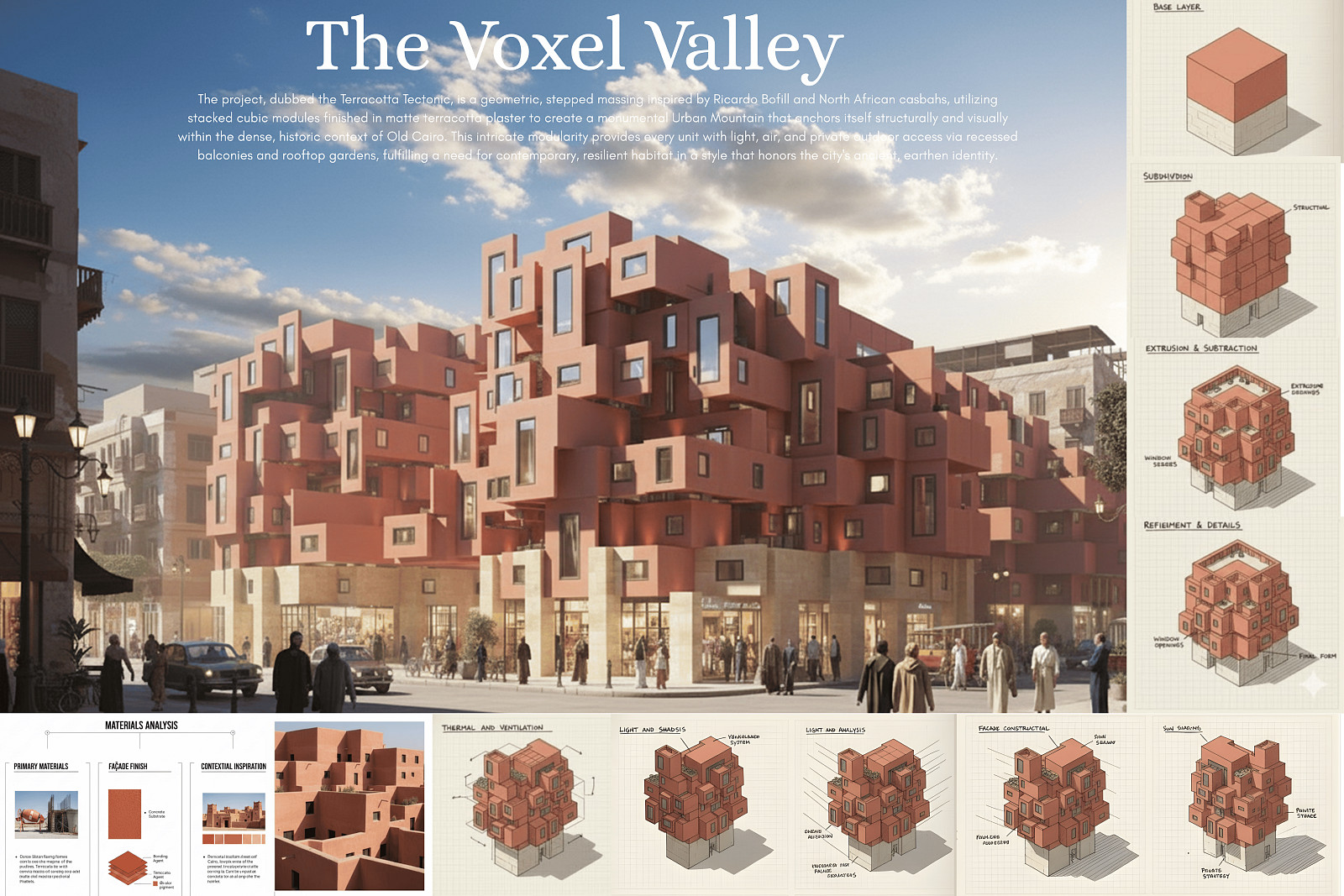
Terracotta Tectonic is a contemporary residential and mixed-use intervention rooted in the architectural memory of Old Cairo. Conceived as an “Urban Mountain,” the project is defined by a bold, stepped geometric massing that reinterprets the monumental language of Ricardo Bofill and the compact, layered morphology of North African casbahs. The building is composed of stacked cubic modules that rise organically from the ground, establishing a strong structural and visual anchor within the dense historic fabric of the city.
Finished in a matte terracotta plaster, the project draws directly from Cairo’s earthen palette, allowing the architecture to blend seamlessly with its surroundings while asserting a powerful, timeless presence. The tectonic expression emphasizes solidity, rhythm, and repetition, reflecting both ancient construction traditions and contemporary modular design principles.
The stepped configuration ensures that every unit benefits from natural light, cross-ventilation, and access to private outdoor spaces through recessed balconies and landscaped rooftop gardens. These terraces act as transitional zones between interior and exterior, enhancing environmental comfort while fostering a strong relationship with the urban context.
Terracotta Tectonic responds to the need for resilient, modern living within a historic setting by combining climatic responsiveness, modular efficiency, and cultural continuity. The project does not imitate the past, but rather abstracts and re-assembles its essence, offering a future-oriented habitat that respects Old Cairo’s identity while redefining its urban skyline.
Technické informace
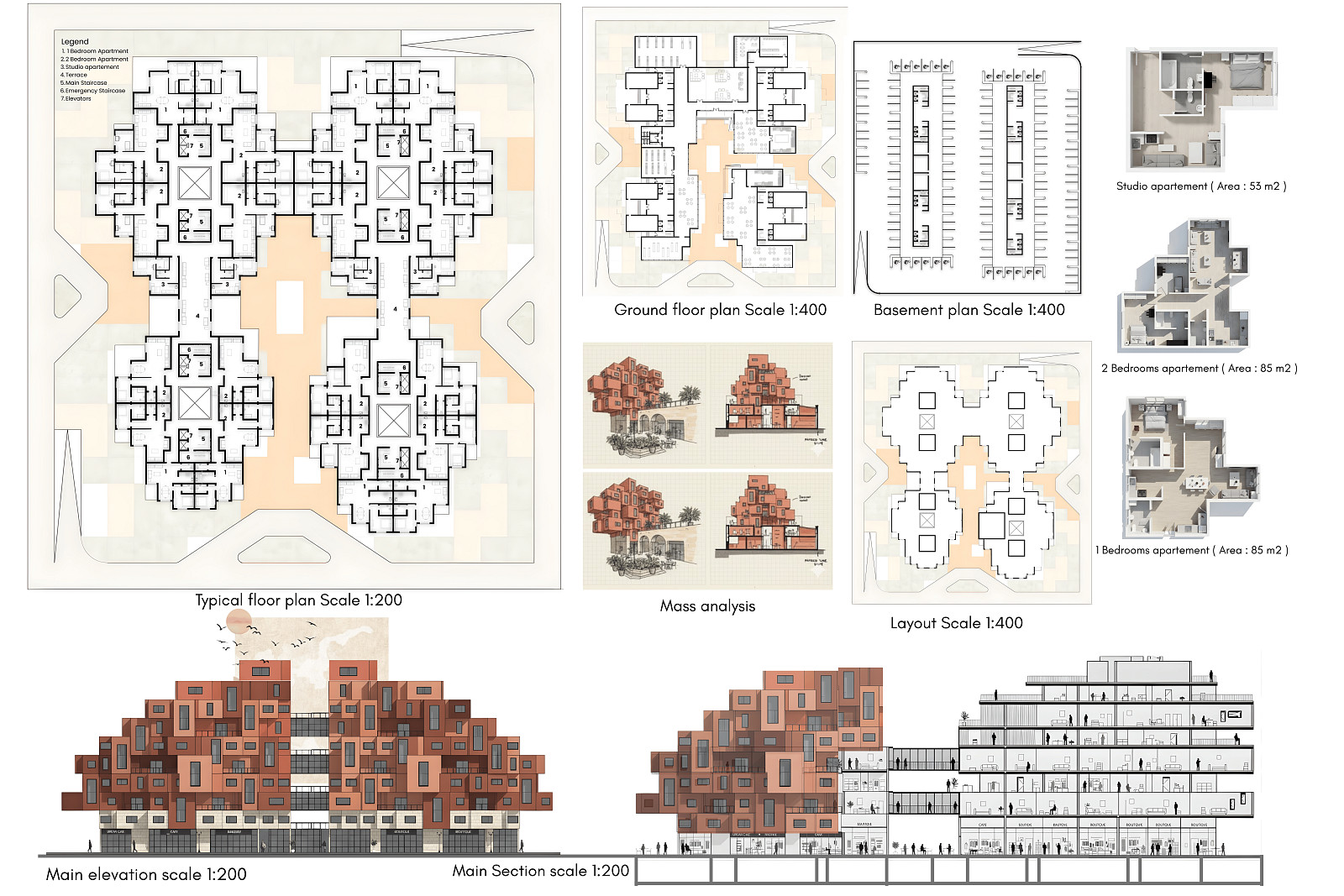
The construction and structural concept of the project is driven by clarity, repetition, and robustness, reflecting both contemporary engineering logic and the enduring principles of traditional courtyard architecture. The project is organized around four primary internal courts that function as structural voids and environmental regulators. These courts penetrate the mass of the building vertically, reducing structural spans, improving natural lighting, and enabling effective cross-ventilation while recalling the inward-looking spatial logic of historic Cairene housing.
Structurally, the building relies on a regular reinforced concrete frame system aligned with the modular cubic units. Load-bearing columns and shear walls are strategically positioned along the edges of the four courts and around the vertical circulation zones, allowing the stepped massing to remain stable despite its complex geometry. The courts act as structural anchors within the overall mass, helping distribute vertical and lateral loads efficiently down to the foundation while minimizing excessive cantilevers.
Vertical circulation and building services are consolidated intoeight structural cores, evenly distributed across the plan to ensure both structural balance and functional efficiency. Each core contains staircases, elevators, and service shafts, acting as rigid vertical spines that resist lateral forces such as wind and seismic loads. Their repetition reinforces the modular logic of the project and allows the large footprint to function as a series of interconnected yet independently legible residential clusters.
Together, the four courts and eight cores create a highly rational construction system beneath the project’s expressive form. This strategy enables phased construction, structural redundancy, and long-term adaptability, while ensuring that the monumental “Urban Mountain” remains efficient, safe, and deeply rooted in both modern engineering practice and the architectural traditions of courtyard-based living.

Copyright © 2026 INSPIRELI | All rights reserved. Use of this website signifies your agreement to the Terms of Use, Privacy Policy, and use of cookies.