SILVERLINE-Mercedes-Benz Experience Centre & Commercial Hub


Idea projektu
SILVERLINE – Mercedes-Benz Experience Centre & Commercial Hub is envisioned as a contemporary urban landmark that translates the brand’s legacy of innovation, precision, and performance into an immersive spatial experience. The project is conceived as more than a conventional showroom or retail complex; it functions as an experiential destination where architecture becomes a medium to narrate the evolution of mobility, design, and lifestyle associated with Mercedes-Benz.
The central idea of SILVERLINE is derived from the notion of continuity- a continuous “line” of movement that connects history, present innovation, and future mobility. This idea is expressed architecturally through fluid circulation, layered spatial sequencing, and interconnected public and commercial zones that guide visitors through curated experiences rather than isolated functions. The building is designed as a journey, where movement itself becomes the primary design driver.
Situated within an urban commercial context, the project integrates a Mercedes-Benz experience centre with a mixed-use commercial hub to create a vibrant public interface. The lower levels are designed as highly accessible public realms housing exhibitions, interactive galleries, and brand experiences, while the upper levels accommodate commercial, lifestyle, and office functions. This vertical stacking ensures functional efficiency while maintaining a strong experiential narrative.
The project aims to establish a seamless relationship between architecture, brand identity, and urban life. By combining experiential architecture with commercial viability, SILVERLINE seeks to create a dynamic civic destination that not only showcases the Mercedes-Benz ethos but also contributes actively to the urban fabric through public engagement, economic activity, and spatial continuity.
Popis projektu
Project Description
SILVERLINE – Mercedes-Benz Experience Centre & Commercial Hub is proposed as a mixed-use experiential development that integrates an automotive brand experience with a commercial and lifestyle-oriented public destination. The project is conceived to move beyond the idea of a conventional showroom by creating a spatial narrative that communicates Mercedes-Benz’s heritage, technological innovation, and future vision through architecture.
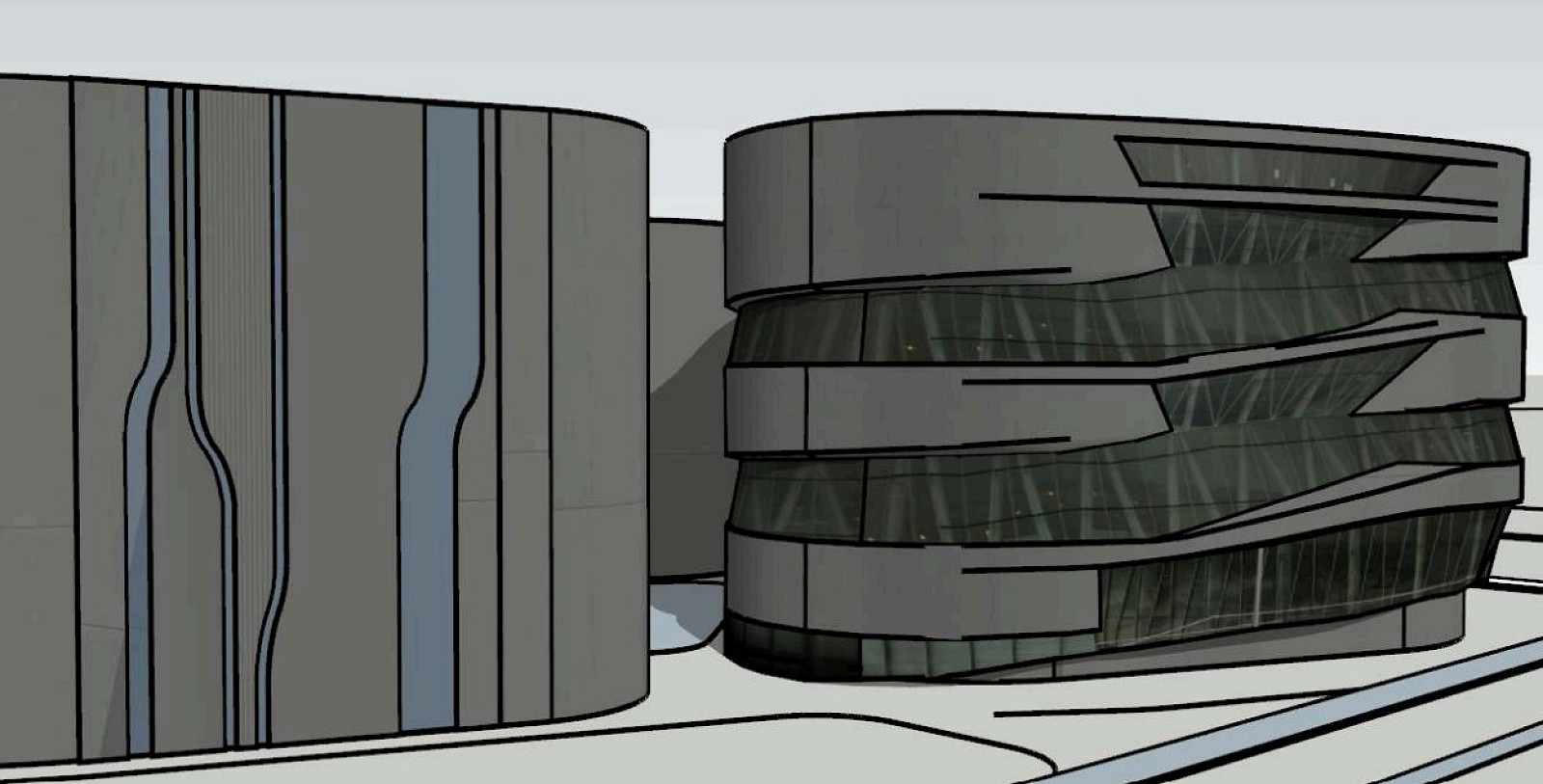
The experience centre forms the core of the project and is organized as a sequence of curated exhibition spaces, interactive galleries, AR/VR zones, and thematic displays that guide visitors through the evolution of the brand. This experiential journey is structured around a central atrium, which acts as the visual and spatial anchor of the building, enabling orientation, visual continuity, and interaction across multiple levels. The architectural form is derived from a trefoil geometry, symbolizing interconnectedness and motion, with the triangular atrium acting as the heart of the experience.
Complementing the experience centre, the commercial hub introduces anchor stores, mid-sized retail units, food and beverage outlets, cafés, and flexible event spaces. The commercial block is conceived as an embracing urban form that frames a public plaza, encouraging pedestrian movement and prolonged engagement. Outdoor kiosks, an open-air theatre, and landscaped public zones further enhance the project’s role as a civic destination rather than an isolated commercial complex.
The project responds to its urban context by creating clear separations between pedestrian, vehicular, and service movements, while ensuring accessibility and visibility from major arterial roads. Vertical stacking of functions, basement parking, and integrated service cores ensure operational efficiency without compromising the experiential quality of public spaces. Overall, the project aims to establish a landmark that merges brand identity, public engagement, and commercial activity into a cohesive architectural statement.
Scope of the Project Solution
The scope of SILVERLINE encompasses architectural, spatial, and functional solutions that address experiential, commercial, and urban requirements within a single integrated development. The project includes the design of a Mercedes-Benz experience centre with exhibition galleries, brand history zones, themed displays, AR/VR experiences, merchandise areas, cafés, and client interaction spaces. These spaces are designed to function as an immersive narrative sequence rather than independent rooms.
The commercial scope includes anchor retail units, mid-sized shops, retail bazaar spaces, food courts, restaurants, and lifestyle amenities that support economic viability and enhance footfall. Outdoor components such as festival kiosks, art and culture clusters, an open-air theatre, and public plazas are integrated to extend activity beyond enclosed interiors and activate the site throughout the day.
From an architectural and planning perspective, the scope covers site zoning, circulation planning, basement and surface parking, service integration, and future expansion provisions. Climate-responsive design strategies, orientation-based massing, shaded public realms, and material selection reflecting both local context and automotive precision are incorporated as part of the design solution.
The project ultimately addresses the dual objective of creating a strong brand-driven experiential environment while functioning as a commercially sustainable, publicly accessible urban hub that contributes positively to the surrounding city fabric.
Technické informace
Project Title
SILVERLINE – Mercedes-Benz Experience Centre & Commercial Hub
Project Type
Mixed-use development comprising an automotive experience centre, commercial retail spaces, food and beverage outlets, office and administrative areas, and public open spaces.
Site Details
Location: Jagatpura, Jaipur, Rajasthan, India
Site Area: ~13,600 sq.m
Plot Type: Corner plot with access from three sides
Land Use: Commercial / Mixed-use (as per JDA Master Plan)
Planning Controls (As per JDA Regulations)
Ground Coverage: ~35%
Maximum FAR: 2.25
Achieved Built-up Area: ~30,000 sq.m (approx.)
Setbacks:
Front: 6.0 m
Sides: 3.0 m
Rear: 3.0 m
Maximum Permissible Height: As per 1.5 × abutting road width
Functional Zoning
Basement Levels:
Vehicular parking (two- and four-wheelers)
Service areas, electrical rooms, HVAC plant, STP and water services
Ground Floor:
Public plaza, anchor retail, primary exhibition areas, brand display zones
First–Third Floors:
Experience galleries, themed exhibitions, AR/VR zones, retail bazaar units
Fourth Floor:
Food and beverage outlets, cafés, conference rooms, administration
Fifth Floor:
Logistics, meeting areas, fitness and wellness spaces, open terraces
Parking Provision
Basement Parking:
Four-wheelers: ~120 ECS
Two-wheelers: ~100 spaces
Surface Parking: Visitor and valet parking
EV Charging Stations: Provided within parking zones
Parking Design: As per JDA and NBC norms
Structural System
Type: Reinforced Cement Concrete (RCC) framed structure
Column Grid: Modular grid system for flexible planning
Slab System: Flat slab / conventional RCC slab (as per span requirement)
Foundation: Isolated / combined footing (based on soil investigation)
Circulation & Accessibility
Separate pedestrian, vehicular, and service entries
Central atrium facilitating vertical and visual connectivity
Multiple staircases, passenger lifts, and service lifts
Barrier-free access with ramps, lifts, and accessible toilets as per NBC
Fire & Life Safety
Designed as per NBC 2016 – Part 4
Fire staircases, refuge areas, fire lifts
Automatic sprinkler system, fire hydrants, hose reels
Smoke extraction and pressurization systems
Clearly defined fire escape routes and assembly areas
Building Services
HVAC: Centralized air-conditioning with AHUs
Electrical: 3-phase power supply with DG backup
Water Supply: Municipal supply with underground and overhead tanks
Waste Management: Segregated waste collection and disposal
STP: On-site sewage treatment plant
Rainwater Harvesting: Provided as per local norms
Materials & Finishes (Indicative)
Exterior: Local sandstone cladding, aluminum panels, high-performance glazing
Interior Floors: Stone flooring, vitrified tiles, polished concrete
Façade Treatment: Shaded façades with integrated lighting elements
Landscape: Hardscape plazas, water features, soft landscaping
Sustainability Measures
Orientation-based massing to reduce heat gain
Shaded public plazas and semi-open spaces
Natural ventilation in transitional spaces
Energy-efficient lighting and water fixtures
Provision for future renewable energy integration
Construction & Façade – Technical Details
Overall Construction System
Structural System: Reinforced Cement Concrete (RCC) framed structure
Construction Type: Cast-in-situ RCC with modular planning grid to support large column-free spans in exhibition and retail areas
Floor System: RCC flat slab / beam–slab system optimized for vehicular load zones and public assembly spaces
Atrium Structure: RCC core with peripheral columns supporting long-span slabs around the central atrium void
Façade System
The façade design of SILVERLINE combines high-performance curtain wall systems with solid cladding elements, reflecting Mercedes-Benz’s identity of precision, transparency, and material refinement while responding to Jaipur’s composite climate.
1. Curtain Wall System (Primary Transparent Façade)
Type: Unitized aluminum curtain wall system
Glazing:
Double-glazed insulated glass units (IGU)
Low-E coated glass to reduce solar heat gain
Outer pane: Toughened glass
Inner pane: Laminated safety glass
Frame Material: Powder-coated aluminum mullions and transoms
Fixing:
Mechanically anchored to RCC slab edges
Adjustable brackets to accommodate thermal movement
Performance:
High daylight penetration for exhibition and retail zones
Solar heat gain control suitable for west-facing façades
Acoustic insulation for interior comfort
Application Areas:
Main experience centre façade
Atrium-facing elevations
Retail frontage and public interface zones
2. Solid Cladding System (Secondary Façade)
Material Palette:
Locally sourced Jaipur sandstone panels
Brushed / anodized aluminum composite panels (ACP)
Cladding System:
Dry cladding fixed on aluminum sub-frame
Ventilated cavity between wall and cladding for thermal performance
Panel Dimensions:
Modular panel sizes for ease of installation and replacement
Fixing Method:
Stainless steel anchors and brackets
Concealed fixing system to maintain clean façade lines
Thermal Performance:
Air cavity improves insulation and reduces heat transfer
Stone mass provides thermal buffering against extreme temperatures
3. Shading & Solar Control Elements
Horizontal aluminum fins integrated with the façade
Recessed glazing to reduce direct solar exposure
Deep overhangs and self-shading forms generated through building geometry
Façade articulation aligned with sun path and west-facing heat mitigation strategies
4. Integrated Lighting System
Linear LED lighting embedded within aluminum façade bands
Accent lighting highlighting horizontal movement and architectural lines
Low-energy LED fixtures with concealed wiring channels
Night-time illumination reinforces the “Silverline” identity and landmark presence
5. Waterproofing & Weather Protection
Silicone sealant joints in curtain wall systems
EPDM gaskets for airtightness and water resistance
Drip edges and flashing at slab edges
Proper drainage channels at façade base and terraces
6. Maintenance & Durability
Unitized curtain wall allows easy panel replacement
Stone cladding treated with weather-resistant sealants
Aluminum components corrosion-resistant and low maintenance
Access provisions for façade cleaning integrated into service planning
Façade Performance Summary
Transparency vs. Solidity Balance:
Curtain wall expresses openness and brand visibility; stone cladding anchors the building in local context.
Climate Responsiveness:
Combination of shaded glazing, ventilated cladding, and thermal mass addresses Jaipur’s hot-dry conditions.
Brand Expression:
Clean horizontal lines, precision detailing, and material refinement reflect Mercedes-Benz’s design language.
Dokumentace

Copyright © 2026 INSPIRELI | All rights reserved. Use of this website signifies your agreement to the Terms of Use, Privacy Policy, and use of cookies.