The Musical Garden

 Ibrahim Elhadidi
Project idea
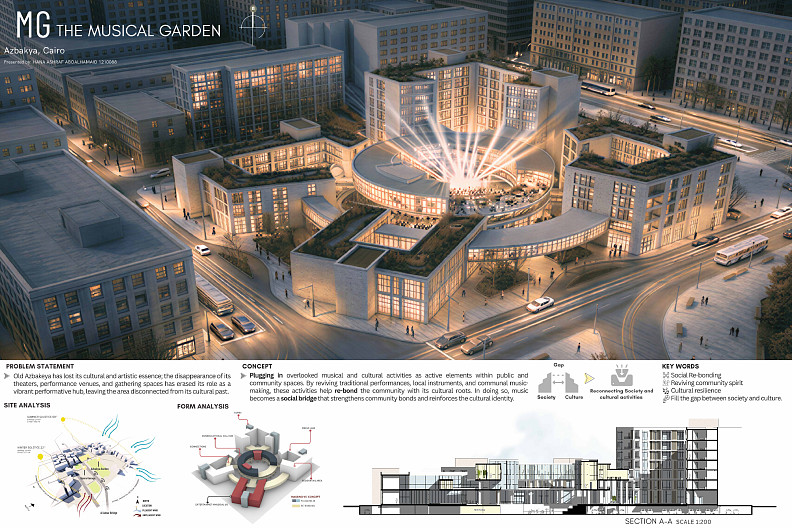
The idea of this project arises from the cultural and social decline of Old Azbakeya, an area that historically functioned as a major artistic and performative hub in Cairo. The disappearance of theaters, performance venues, and communal gathering spaces has erased much of its cultural identity, leaving the district disconnected from its artistic past and daily social life.
The project proposes a cultural–residential hybrid that plugs overlooked musical and cultural activities into everyday living environments. By embedding traditional music, performances, and communal cultural practices within a complex housing typology, the project transforms housing from a purely residential function into an active social framework. Music becomes a catalyst for interaction, acting as a social bridge that re-bonds residents and visitors with Azbakeya’s cultural roots while reinforcing collective identity and community cohesion.
Project description
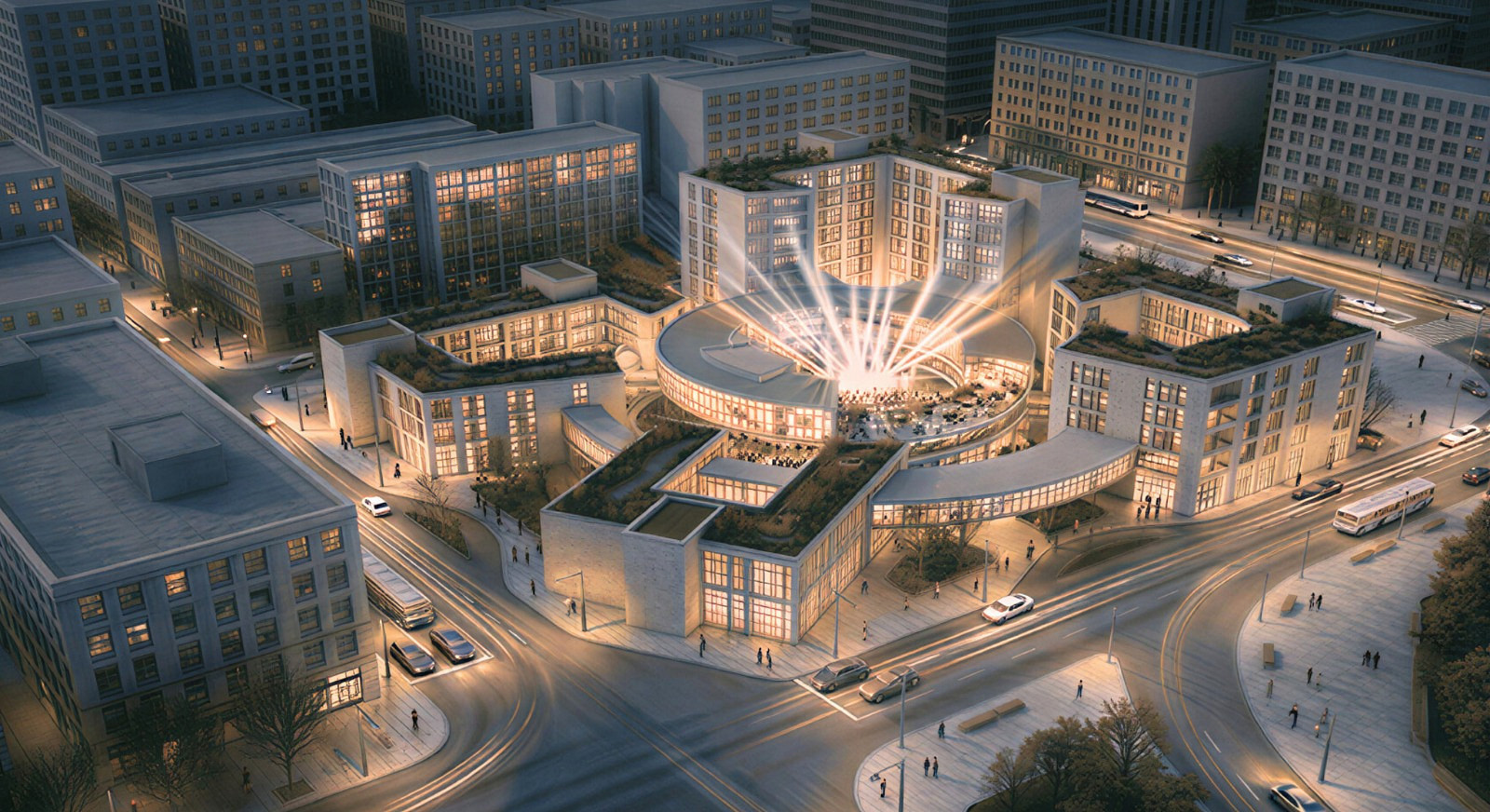
The project is conceived as a cultural plug-in within a complex housing typology, responding to the loss of Old Azbakeya’s cultural and artistic identity. A circular mass forms the musical hub of the project, containing an amphitheater for entertainment and educational activities and acting as a focal point for community gathering. This cultural core is physically and spatially plugged into linear residential masses, allowing music and performance to become an integral part of everyday residential life rather than a separated function.
The ground floor is predominantly public, accommodating a music library, cultural exhibition spaces, multipurpose event halls, interactive singing spaces for youth, instrument workshops and boutiques, musical accessories shops, orchestral instrument shops, and media labs for music production. The first level introduces a semi-private layer where residential units are connected through a circular circulation system overlooking the public cultural spaces, reinforcing interaction while maintaining privacy. The upper levels are primarily residential, creating a vertical transition from active public culture to private living and redefining housing as a catalyst for cultural regeneration.
Technical information
The building is primarily constructed using a reinforced concrete flat slab structural system, providing flexibility in residential layouts and efficient load distribution. Reinforced concrete frame structures are utilized in areas requiring wider spans, particularly within public and cultural spaces, to accommodate open and adaptable interiors.
The circular connections and transitional elements are supported by steel truss systems, allowing these components to appear floating and column-free while maintaining structural efficiency. This hybrid structural approach enables the integration of large public spaces within a dense housing complex, balancing architectural expression, structural performance, and functional requirements.
Documentation

Copyright © 2026 INSPIRELI | All rights reserved. Use of this website signifies your agreement to the Terms of Use, Privacy Policy, and use of cookies.