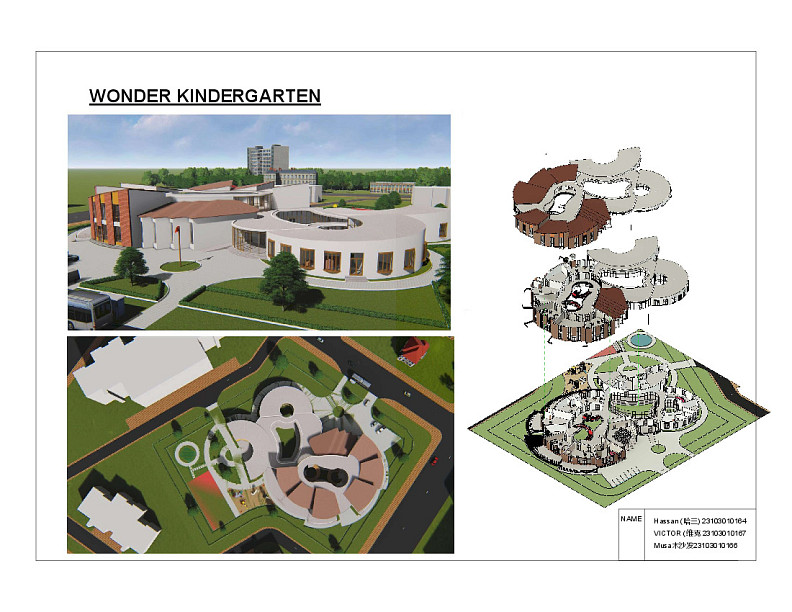
WONDER KINDERGARTEN


Project idea
Project Title
WONDER KINDERGARTEN – A Community-Oriented Early Childhood Learning Environment
Wonder Kindergarten is conceived as a new place for people, where early childhood education extends beyond classrooms to become a shared social and developmental environment for children, teachers, parents, and the surrounding community. The project responds to the growing need for learning spaces that support creativity, play, safety, health, and social interaction during the most critical stage of human development.
Rather than functioning as a closed educational facility, the kindergarten is designed as an open, welcoming learning village, where indoor and outdoor spaces work together to encourage exploration, movement, and curiosity.
Need for the Project
Conventional kindergartens often prioritize rigid classrooms and limit children’s interaction with nature and social spaces. In contrast, Wonder Kindergarten addresses:
The need for child-centered learning environments
The importance of play-based and experiential education
The demand for safe, healthy, and flexible spaces
The role of early education as a community anchor
The project recognizes that children learn best through movement, interaction, and imagination, and therefore architecture becomes an active educational tool.
Design Inspiration
The design draws inspiration from:
Children’s natural curiosity and sense of wonder
Playgrounds and learning villages, where movement and discovery are continuous
Nature-inspired forms and circulation, encouraging freedom rather than confinement
Courtyard-based spatial organization, creating visual connection and supervision
Concept & Spatial Strategy
The kindergarten is organized around:
Clear circulation zones that allow easy orientation for children
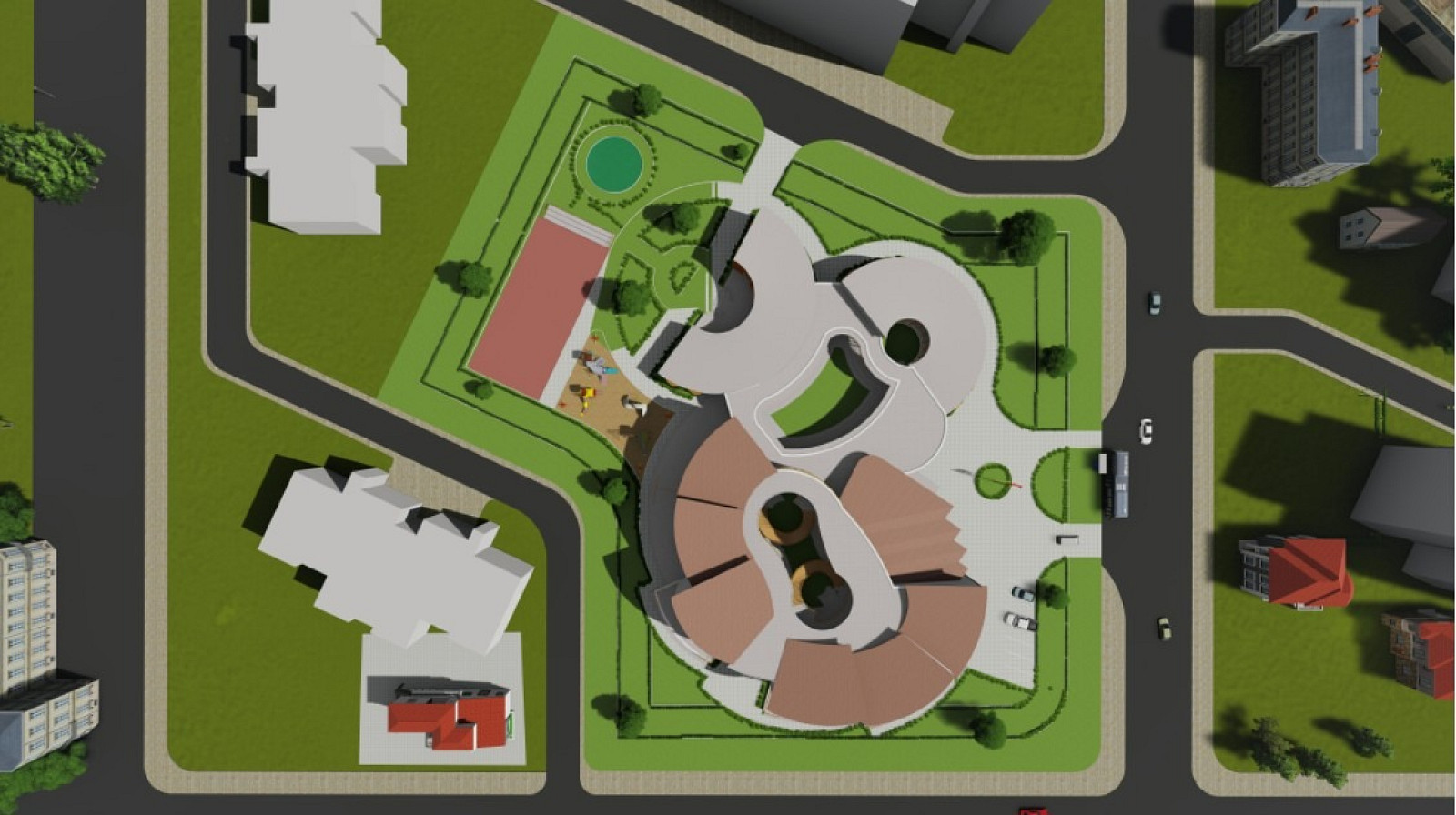
Multiple classrooms connected to shared play and activity areas
A multifunctional activity room for group learning, performances, and creative expression
Outdoor playing areas integrated at different levels
Administrative, health, and service spaces positioned for safety and efficiency
The vertical stacking of classrooms and play areas allows for progressive learning environments, while maintaining safety and visibility across floors.
Project description
Project Description
Wonder Kindergarten is an early childhood education facility designed to support holistic learning through play, interaction, and spatial exploration. The project creates a safe, stimulating, and inclusive environment where architecture actively contributes to children’s cognitive, social, and emotional development. Classrooms are organized around clear circulation and shared activity spaces to encourage movement, visibility, and collaboration. Indoor learning areas are closely connected to outdoor playing zones, reinforcing the relationship between education and nature. A multifunctional activity room, health facilities, administrative offices, and service areas ensure smooth daily operation and child safety. By combining flexible learning spaces with child-scaled design and community-oriented planning, Wonder Kindergarten functions not only as a school but as a nurturing environment that fosters curiosity, creativity, and early social development.
Technical information
Technical Information
Wonder Kindergarten is a multi-level educational facility designed with a clear functional zoning system to ensure safety, efficiency, and ease of movement. The building consists of classrooms, multifunctional activity rooms, administrative offices, health facilities, service areas, and outdoor play spaces distributed across different floors. Circulation areas are wide and clearly defined to support child-friendly movement and supervision. The structural system is based on a reinforced concrete frame, allowing flexible spatial layouts and future adaptability. Large window openings provide adequate natural lighting and cross-ventilation, improving indoor comfort. Sanitary spaces are strategically located near classrooms for accessibility. Outdoor playing areas are integrated at various levels to maximize space use. The design follows standard educational building regulations, emphasizing safety, durability, accessibility, and environmental comfort.
Documentation

Copyright © 2026 INSPIRELI | All rights reserved. Use of this website signifies your agreement to the Terms of Use, Privacy Policy, and use of cookies.